Showing posts with label shallots. Show all posts

Tuesday, September 5, 2023

BGF NEWS - September 5, 2023 - VOL. 50, NO. 13

IN THIS WEEK’S BOX:


Basil: Genovese and/or Large Leaf
Bean Mix: Empress (green) & Carson (yellow)
Cucumbers: Corinto, Generally, Lemon, Marketmore, Nokya or Sashimi 
Jubilee Cherry Tomato Mix: see 8/1 newsletter for descriptions
Peppers: Sweet, see 8/15 newsletter for descriptions
Potatoes: Carola
Roselle: leaves & calyxes 
Shallots: Ambition (tan) and/or Prisma (red)
Tomatoes: see 8/1 for descriptions. 

and perhaps one of the following:
Broccoli Florets
Okra: Bowling Red & Candle Fire


Herb It! option: Nunum Basil, Lemon Balm, Stevia

Jam It! option: Tart Cherry Jam & Golden Fire Pepper
Spice It Up! Option: Rosemary-Meyer Lemon Salt
Bread Share: Apple Bread


Featured Recipes:
BGF Pesto **see below

WHAT’S UP ON THE FARM?
Precipitation in the past week: 0.00"

Happy September from the farm! Clearly August is having a tough time exiting gracefully but it sounds like the temperatures are supposed to drop a bit later this week. We are certainly ready for it...and rain, please, please rain! 

Despite the inhospitable conditions, we have continued to put fall transplants in the ground and sow fall seeds. The transplants are a bit grouchy with the conditions and we are struggling to get enough irrigation water on the seeded crops for them to germinate, but it is starting to happen. 
And as long as we can pull it through the current heat wave, we will hopefully be back to harvesting head lettuce next week. This is definitely a hello and goodbye time of the year. Hello to roselle and a fond farewell to summer squash and cucumbers. I think we'll get one more week of eggplant and okra, then they too will be done for the season.

We spent the past week trying to stay ahead of the tomato harvest and irrigation needs. We cleared more spent beds, planted Beijing Express greens and head lettuce but most of our "other" time was taken up by the popcorn harvest! 
This is the earliest we've ever harvested popcorn but it was so dry in the field that the ears were starting to drop on the ground, so the time is now! At this point we are about 80% done and so far it looks really good, despite 2 hail storms, severe drought and no irrigation. We won't know for sure until it is fully dried and shelled, but right now it looks like a record breaking popcorn crop!

Now back to the roselle. We are excited to send it out in this week's delivery. For those of you unfamiliar, it is an edible member of the hibiscus family and the leaves have a tart, lemony flavor. It is delicious added to pesto and in combination with other greens. I really like it added to (or instead of) lettuce on my sandwiches. Give it a try and see what you think. Here's a concise page about roselle greens and their uses: Roselle. We are including the calyxs of the roselle as well. This is a favorite ingredient in Asian, Carribean and African 
countries. It's largely used dried for making both hot teas and refreshing chilled beverages but we like it chopped up and added to salads and sweets as well. Be sure to remove the white seed pod from the inside and only eat the tender red parts.

Upcoming Dates to Note:
Tues, Oct. 24: Final CSA delivery
Sat, Oct. 28: Final Saturday VegEmail delivery
Tues, Nov. 7: Fall VegEmail schedule begins, delivery every 2 weeks.


A LITTLE DETAIL ON YOUR PRODUCE THIS WEEK:

Basil hates the cold and will turn black with exposure. Keep long stemmed basil in a glass/vase of water on your counter top (out of direct sunlight). Stems that are too short (trimmings/tops) should be placed in a glass or plastic container with a dry paper towel. Then put inside of a paper bag (for insulation) and put in the warmest part of your refrigerator (usually the door) or on the top shelf towards the front.

Beans: Fresh beans are an easy "store." Just leave them in their plastic bag and keep them in the produce drawer. Can last up to 2 weeks.

Cucumber: Store unwashed cucumbers in a sealed plastic bag in the vegetable crisper bin for about a week. Keep cucumbers tucked far away from tomatoes, apples, and citrus—these give off ethylene gas that accelerates cucumber deterioration. You can do a lot of fancy things to the skin of a cucumber, but when it is young, fresh (and unwaxed), it really only needs to be thoroughly washed. However, if the skin seems tough or bitter you can remove it; if the seeds are bulky, slice the cucumber lengthwise and scoop them out.


Okra: These lovely, dark red, horn-shaped vegetables are a warm weather treat. Extremely cold sensitive, store in their plastic bag in the warmest part of your fridge, or place the plastic bag in a small paper sack and store in the crisper drawer and use within the week. Traditional southerners will cut into rounds, bread in cornmeal and fry, but our favorite version is our dear friend Annie's method, "All I do is rinse off the pods and lay them in a saucepan with a little water in the bottom. Ten to fifteen minutes is all it takes...twenty if the pods are really big and "woody" feeling. I put salt on them and eat as finger food. It reminds me of young sweet corn."

Peppers:  Place whole, unwashed peppers in a plastic bag, seal, and refrigerate for a week or more. Rinse peppers just before use. For sweet peppers, cut around the stem with a small knife and lift out the core. Slice down the side to open it up and then cut out the inner membranes. Store unused portions in a sealed bag or container in the refrigerator.

Potatoes: Keep unwashed potatoes in a cool, dark, dry place, such as a loosely closed paper bag in a cupboard. They will keep for weeks at room temperature, longer if you can provide their ideal temperature of 40 to 50 degrees. Beware: the low temperature of your refrigerator will convert the starch to sugars. So refrigerated potatoes should be brought to room temperature for at least 24 hours before using. Moisture causes potatoes to spoil, light turns them green, and proximity to onions causes them to sprout. (You can still use a potato that has sprouted, however; simply cut off the “eyes” before use.) Scrub potatoes well and cut off any sprouts or green skin. (Clean delicate new potatoes gently.) Peeling is a matter of preference. Cut potatoes according to your recipe. If baking a whole potato, be sure to prick the skin in at least a few places to allow steam to escape.

Roselle: Store in a cloth or paper-lined plastic bag in the produce drawer of your refrigerator and use within a week.

Shallots: A "high-brow" member of the onion family, shallots have a smooth, rich onion-y flavor that is perfect with egg, vegetable and salad dressing recipes. Cured shallots are stored like a cured onion or garlic (at cool room temp) for many months.  Once you cut into a shallot bulb, store the remainder in a sealed container in the fridge.

Tomatoes: always store whole tomatoes at room temperature, out of direct sunlight. Once cut, store in a sealed container in the refrigerator.


A few other details: All of your GREENS will keep best if stored in a plastic bag, with the top folded over and placed in the produce drawer of your refrigerator.

** NOTE: You will notice over the course of the season that some box contents listed above say "Perhaps one of the following..." These are items that we can’t harvest in sufficient quantities for the whole CSA to receive at one time. We do track who gets what and we will do our best to ensure that everyone eventually receives each item. On some items this may take several weeks, so please be patient.


Is a weekly newsletter not enough for you? Do you want to read more about our life on the farm and see more pictures? Follow us on Facebook at Blue Gate Farm or on Instagram at bluegatefarmfresh. CSA members can also connect with other BGF members to share recipes or ask questions on our FB community page at Blue Gate Farm Community.

That's about it for now.
If you have any questions or comments, be sure to let us know.

Best from the farm,
Jill & Sean (and the whole BGF crew)


BGF Pesto
2 Tbs Sunflower seeds-toasted (can substitute pine nuts)
2 cloves Garlic ( or garlic scapes, garlic lovers can add more)
2 c. Basil (any variety, a mix is particularly nice)
½ c. Sorrel or Roselle (optional)
½ c. Olive oil
1 tsp Salt (if using pre-salted sunflower seeds, can reduce salt amount)
½ c. Parmesan cheese, fresh grated (not the stuff in the can)
1 medium ripe tomato

Place sunflower seeds and garlic into food processor then pulse several times. Add basil and sorrel, drizzle with half of oil. Pulse several times.  Add remaining oil, Parmesan cheese, tomato and salt if desired.
Pesto should be stored for a week or less in the refrigerator in a sealed container.  If storing longer, freeze in snack-sized, zip-top bags (about 1 1/2 TBS per bag), pressed flat. Once frozen, they can be stored upright in a larger plastic bag. To use a little, just break off the amount needed and return the rest to the freezer.

Tuesday, July 25, 2023

BGF NEWS - July 25, 2023 - VOL. 50, NO. 7

IN THIS WEEK’S BOX:


Bean Mix: Empress (green) & Carson (yellow)
Cucumbers: Corinto, Generally, Lemon, Marketmore, Nokya or Sashimi 
Eggplant: Orient Express, Asian Delight and/or Listada
Fennel
Garlic: Northern White
Head Lettuce: asst var.
Kale
Oyster Mushrooms: Golden or Pearl
Shallots: Ambition (tan) and/or Prisma (purple)
Summer Squash: 8 Ball, Golden Glory, Patty Pan, Safari, Slik Pik, or Zephyr
Turnips: Hakurei

and perhaps one of the following:
Cantaloupe: Minnesota Midget
Jubilee Cherry Tomato Mix or Slicing Tomato
Okra: Bowling Red & Candle Fire
Snow Peas: final offering

Herb It! option: Sweet Basil, Pink Celery, Dill

Bread Share: Tomato Basil


Featured Recipes:
Chinese Eggplant Salad (thanks for the link, Sara T!)

WHAT’S UP ON THE FARM?

Precipitation in the past week: Trace

Well, this week was better than last, but we certainly are missing the rain again. Cue the irrigation system! 

We spent quite a bit of our crew time continuing to clear spent and hail-damaged crops but hopefully we are getting to the bottom of that task. Yesterday we finally took buckets out to the tomato field and cleared all the damaged fruits we could find. It was more than a little demoralizing, but at least now we don't have to look at them anymore. While we were out there, we did our first tomato "training," introducing the crew to the new varieties and talking through the tomato harvest, and then we harvested tomatoes!! Not a lot, not yet, but we should have enough for everyone to get a "taste" of either cherry tomatoes or a slicer this week. We'll do a "meet the tomatoes" post in next week's newsletter.

We were also pleased to find the first of the cantaloupe ripening...actually the deer told us, as they can smell a ripe melon all the way across the field, and then they paw it off the vine and eat it, even in the high tunnel! Grrrrr! They're like giant, long-legged racoons in their attraction to tasty crops. Ah well, they didn't get them all (yet) so we are sending out the first few "Minnesota Midgets" in your boxes this week. 

And I almost forgot the other big news, due to the rains a couple of weeks ago, the oyster mushrooms have exploded this week! We're excited because it means we found enough for the whole CSA to get some. It's just a small amount, but we love to share them when the opportunity presents itself. We hope you enjoy this little "extra".

As I mentioned earlier, we are back to desperate need of rain and with the forecast of 90's  - 100° it's only getting worse. This kind of heat is really hard on the crew, the animals and the crops and just as we are ready to start planting cool-weather fall crops too. Somehow it seems like that's the way it always goes.
Weather like this makes it hard to get much done as we need to stop for extra shade and water breaks. 
The alpacas love getting sprayed down with the hose in this weather. I'm thinking of trying it with the crew! 


A little detail on your produce this week:


Beans: Fresh beans are an easy "store." Just leave them in their plastic bag and keep them in the produce drawer. Can last up to 2 weeks.

Cantaloupe: If your cantaloupe seems a bit short of ripe, keep it at room temperature for a few days or until there is a sweet smell coming from the stem end. Once the melon ripens, store it in the refrigerator. It is best not to cut a cantaloupe until you are ready to eat it. If you need to return cut melon to the refrigerator, do not remove the seeds from the remaining sections as they keep the flesh from drying out. Use within 3-5 days.

Cucumber: Store unwashed cucumbers in a sealed plastic bag in the vegetable crisper bin for about a week. Keep cucumbers tucked far away from tomatoes, apples, and citrus—these give off ethylene gas that accelerates cucumber deterioration. You can do a lot of fancy things to the skin of a cucumber, but when it is young, fresh (and unwaxed), it really only needs to be thoroughly washed. However, if the skin seems tough or bitter you can remove it; if the seeds are bulky, slice the cucumber lengthwise and scoop them out.

Eggplant: Eggplant prefers to be kept at about 50° F, which is warmer than most refrigerators and cooler than most kitchen counters. Wrap unwashed eggplant in a towel (not in plastic) to absorb any moisture and keep it in the vegetable bin of your refrigerator. Used within a week, it should still be fresh and mild. Many people like to peel, salt, and drain their eggplant to draw out any bitter flavor; however, bitterness develops only in eggplant that has been stored for a while, so with farm-fresh specimens this is generally not necessary. Many recipes call for salting in order to make the vegetable less watery and more absorbent—much like draining tofu. Salting is not an essential step, but it can greatly enhance the taste and texture of your dish and is well worth the extra effort. The shape of an eggplant determines how it is best prepared. Slice a straight, narrow eggplant into rounds for grilling or broiling, and cut a rounded, bulbous eggplant into cubes for stews and stir-fries.

Fennel: Cut off the stalks where they emerge from the bulb. To use the feathery foliage as an herb, place the dry stalks upright in a glass filled with two inches of water, cover the glass loosely with a plastic bag, and store in the refrigerator for up to five days. The unwashed bulb will keep in a plastic bag in the refrigerator for at least a week. To use, remove any damaged spots or layers. Cut the bulb in half lengthwise and check the inner core. If it’s tough, remove it with a paring knife. Fennel should be washed carefully, because dirt can lodge between the layers of the bulb. Chop or mince the leaves.


Garlic: The garlic is now mostly cured and can be stored on the counter for short term use or in a dark area with good air circulation (like a basement) for longer storage.


Okra: These lovely, dark red, horn-shaped vegetables are a warm weather treat. Extremely cold sensitive, store in their plastic bag in the warmest part of your fridge, or place the plastic bag in a small paper sack and store in the crisper drawer and use within the week. Traditional southerners will cut into rounds, bread in cornmeal and fry, but our favorite version is our dear friend Annie's method, "All I do is rinse off the pods and lay them in a saucepan with a little water in the bottom. Ten to fifteen minutes is all it takes...twenty if the pods are really big and "woody" feeling. I put salt on them and eat as finger food. It reminds me of young sweet corn."

Peas: We grow snow peas (flat pod with little bumps showing immature peas inside) and sugar snap peas (rounded pods with mature peas inside). Both have edible pods and can be used interchangeably in recipes. They are particularly good in stir-fries and salads, though we tend to eat them fresh as a snack. Peas keep best in their plastic container in the produce drawer of your refrigerator.

Shallots: A "high-brow" member of the onion family, shallots have a smooth, rich onion-y flavor that is perfect with egg, vegetable and salad dressing recipes. Cured shallots are stored like a cured onion or garlic (at room temp) for many months. If your shallots have green tops, please hang and store at room temperature until the greens have dried, then trim and store like onions. Once you cut into a shallot bulb, store the remainder in a sealed container in the fridge.

Summer Squash/Zucchini: Refrigerate unwashed zucchini and summer squash for up to a week and a half in a perforated plastic bag or in a sealed plastic container lined with a kitchen towel. These do not need to be peeled to use, just slice them up and go!

Tomatoes: always store whole tomatoes at room temperature, out of direct sunlight. Once cut, store in a sealed container in the refrigerator.

Turnips: keep best if separated from their greens. Greens are stored in a plastic bag and can be cooked like mustard or collard greens. Trimmed roots can go into a lidded container or zip-close bag. These aren't your grandma's turnips. These are a sweet, Japanese salad variety that is particularly tasty for fresh eating. They will still work great in cooked dishes, but we love to eat them raw, often right out of hand, like an apple. One of the farm crew's favorite mid-field snacks.


A few other details: All of your GREENS will keep best if stored in a plastic bag, with the top folded over and placed in the produce drawer of your refrigerator.

** NOTE: You will notice over the course of the season that some box contents listed above say "Perhaps one of the following..." These are items that we can’t harvest in sufficient quantities for the whole CSA to receive at one time. We do track who gets what and we will do our best to ensure that everyone eventually receives each item. On some items this may take several weeks, so please be patient.

Is a weekly newsletter not enough for you? Do you want to read more about our life on the farm and see more pictures? Follow us on Facebook at Blue Gate Farm or on Instagram at bluegatefarmfresh. CSA members can also connect with other BGF members to share recipes or ask questions on our FB community page at Blue Gate Farm Community.

That's about it for now.
If you have any questions or comments, be sure to let us know.

Best from the farm,
Jill & Sean (and the whole BGF crew)


Tuesday, August 30, 2022

BGF NEWS - August 30, 2022 - VOL. XLVIII, NO. 13

In this week’s box:

Basil: Sweet
Chard: Rainbow Mix
Cherry Tomatoes: Jubilee Mix (see description on 8/2)
Head Lettuce: asst
Shallots: Ambition (tan) &/or Camelot (purple)
Sweet Peppers: asst.
Tomatoes-Slicers: asst. (see description on 8/2)
Baby Turnips: Hakurei

and at least one of the following: 
Beans: Provider (green) & Carson (yellow) Mix
Broccoli Florets
Cantaloupe: Hannah's Choice or Minnesota Midget
Cauliflower: Snow Crown or Song
Eggplant: Orient Express, Asian Delight or Listada de Gandia
Okra: Candle Fire and Burgundy
Watermelon: Cream of Saskatchewan 

Herb It! option: lemon basil, garlic chives, bronze fennel
Bread Share: Italian Herb

Featured Recipes:  
BGF Pesto **see below**

What’s up on the farm?

Precipitation in the past week: 0.1" (ugh!)

While we were again very pleased to miss the hail that fell around central Iowa this week, we were very disappointed to also miss almost all of the rain. We did have a couple of brief showers, but it didn't add up to much of anything so we are continuing to irrigate on a daily basis. The drought and decreasing daylight hours are really starting to affect our midseason crops, tomato and eggplant ripening has slowed way down, melons are pretty much done. Peppers are also slowing a bit, but not nearly as much as the others. We had planned to do our annual "Salsa Box" this week, but I wasn't confident that we would have enough tomatoes to really do it justice, so we are postponing it for a week in hopes of greater tomato volume. 

We spent much of the past week taking advantage of our dry conditions and catching up on weeding and cultivating many of the crops on the farm. We continue to clear spent crops like early plantings of kale and lettuce plus melons and replace them with cool weather crops like Purple Peacock, head lettuce, komatsuna, misome, and more arugula. 
We also renovated the spent cucumber bed in the big high tunnel and planted kale and Napa Cabbage. These are crops that we will harvest throughout the winter.
Speaking of crops that are finishing up, we're not there yet, but basil season will be coming to an end in the next month. This is your heads up that now is the time to take advantage of bounteous basil and make a couple batches of pesto to freeze for winter use. Believe me, you will thank yourself for it in January! Our favorite pesto recipe is at the end of the newsletter, including our preferred way to freeze it.

A little detail on your produce this week:


Basil hates the cold and will turn black with exposure. Keep long stemmed basil in a glass/vase of water on your counter top (out of direct sunlight). Stems that are too short (trimmings/tops) should be placed in a plastic bag, with a dry paper towel. Then put inside of a paper bag (for insulation) and put in the warmest part of your refrigerator (usually the door) or on the top shelf towards the front.

Beans: Fresh beans are an easy "store." Just leave them in their plastic bag and keep them in the produce drawer. Can last up to 2 weeks.

Broccoli & Cauliflower: Wrap loosely in a plastic bag and keep it in the vegetable bin of your refrigerator for up to a week. Immediately before cooking, soak head down, in cold, salted water (1 teaspoon salt to a 8 cups of water) for 5 minutes. Any [organic] critters will float to the top where you can rescue them or allow them to suffer a salty death. (Note: If you soak broccoli or cauliflower in salt water before storing, it will become too rubbery and wilted to enjoy.)

Cantaloupe: If your cantaloupe seems a bit short of ripe, keep it at room temperature for a few days or until there is a sweet smell coming from the stem end. Once the melon ripens, store it in the refrigerator. It is best not to cut a cantaloupe until you are ready to eat it. If you need to return cut melon to the refrigerator, do not remove the seeds from the remaining sections as they keep the flesh from drying out. Use within 3-5 days.

Eggplant: prefers to be kept at about 50° F, which is warmer than most refrigerators and cooler than most kitchen counters. Wrap unwashed eggplant in a towel (not in plastic) to absorb any moisture and keep it in the vegetable bin of your refrigerator. Used within a week, it should still be fresh and mild. Many people like to peel, salt, and drain their eggplant to draw out any bitter flavor; however, bitterness develops only in eggplant that has been stored for a while, so with farm-fresh specimens this is generally not necessary. Many recipes call for salting in order to make the vegetable less watery and more absorbent—much like draining tofu. Salting is not an essential step, but it can greatly enhance the taste and texture of your dish and is well worth the extra effort.

Okra: These lovely, dark red, horn-shaped vegetables are a warm weather treat. Extremely cold sensitive, store in their plastic bag in the warmest part of your fridge, or place the plastic bag in a small paper sack and store in the crisper drawer and use within the week. Traditional southerners will cut into rounds, bread in cornmeal and fry, but our favorite version is our dear friend Annie's method, "All I do is rinse off the pods and lay them in a saucepan with a little water in the bottom. Ten to fifteen minutes is all it takes...twenty if the pods are really big and "woody" feeling. I put salt on them and eat as finger food. It reminds me of young sweet corn."

Peppers: Place whole, unwashed peppers in a plastic bag, seal, and refrigerate for a week or more. Rinse peppers just before use. For sweet peppers, cut around the stem with a small knife and lift out the core. Slice down the side to open it up and then cut out the inner membranes. Store unused portions in a sealed bag or container in the refrigerator.

Shallots: the grown-up cousins of onions, shallots have a rich flavor that really shines in soups, sauces, salad dressings and egg dishes. Store like onions in a cool, dark place with good air circulation.

Tomatoes: always store whole tomatoes at room temperature, out of direct sunlight. Once cut, store in a sealed container in the refrigerator.

Turnips: keep best if separated from their greens. Greens are stored in a plastic bag and can be cooked like mustard or collard greens. Trimmed roots can go into a lidded container or zip-close bag. These aren't your grandma's turnips. These are a sweet, Japanese salad variety that is particularly tasty for fresh eating. They will still work great in cooked dishes, but we love to eat them raw, often right out of hand, like an apple. One of the farm crew's favorite mid-field snacks.


Watermelon: Handle watermelons carefully. When harvested at their peak ripeness, they can crack or split easily if bumped or roughly handled. Refrigerate watermelons right away. (Watermelons do not ripen off the vine and do not emanate a ripe smell.) Cut melon should be covered in plastic wrap, chunks or slices should be kept in an airtight container, and both should be refrigerated. Eat all melons within a week.

A few other details: All of your GREENS will keep best if stored in a plastic bag, with the top folded over and placed in the produce drawer of your refrigerator.  

** NOTE: You will notice over the course of the season that some box contents listed above say "Perhaps one of the following..."  These are items that we can’t harvest in sufficient quantities for the whole CSA to receive at one time.  We do track who gets what and we will do our best to ensure that everyone eventually receives each item.  On some items this may take several weeks, so please be patient.

Is a weekly newsletter not enough for you? Do you want to read more about our life on the farm and see more pictures? Follow us on Facebook at Blue Gate Farm or on Instagram at bluegatefarmfresh. CSA members can also connect with other BGF members to share recipes or ask questions on our FB community page at Blue Gate Farm Community.

That's about it for now.
If you have any questions or comments, be sure to let us know.
Best from the farm,
Jill & Sean (and the whole BGF crew)

Sky, Wallace & Gromit


Blue Gate Farm Pesto

2 Tbs Sunflower seeds-toasted (can substitute pine nuts)
2 cloves Garlic (garlic lovers can add more) green garlic or garlic scapes are also good.
2 c. Basil (any variety, a mix is particularly nice)
1-2 leaves Sorrel (optional)
½ c. Olive oil
1 medium tomato
1 tsp Salt (if using pre-salted sunflower seeds, can reduce salt amount)
½ c. Parmesan cheese, fresh grated (not the stuff in the can)

Place sunflower seeds and garlic into food processor then pulse several times. Add basil and sorrel, drizzle with half of oil. Pulse several times. Add remaining oil, tomatoes, Parmesan cheese and salt if desired.

Pesto should be stored for a week or less in the refrigerator in a sealed container. 
 For longer storage, freeze in snack-sized, zip-top bags (about 1 1/2 TBS per bag), pressed flat. Once frozen, they can be stored upright in a larger plastic bag. To use, just break off the amount needed and return the rest to the freezer. Even if you are using the full bag, it is much easier to remove from the bag if you do so while it is still frozen.

Also, if we are making a large batch for the freezer, for best quality, we omit the cheese and seeds. Freeze as is and then add those items in when we are ready to use.

Tuesday, August 2, 2022

BGF NEWS - August 2, 2022 - VOL. XLVIII, NO. 9

In this week’s box:


Basil: Sweet
Beets: Cylindra
Cherry Tomatoes: Jubilee Mix (see list below)
Cucumber: asst
Head Lettuce: asst
Roselle
Shallots- Ambition (tan) &/or Camelot (purple)
Summer Squash: asst

and at least one of the following: (please see **NOTE after "A Little Detail..." below)
Beans: Provider (green) & Carson (yellow) Mix
Cantaloupe: Minnesota Midget
Cauliflower: Snow Crown or Song
Eggplant: Orient Express, Asian Delight or Listada de Gandia
Okra: Bowling Red and Candlefire
Tomatoes-Slicers: asst. (see list below)


Herb It! option: Nunum Basil, bronze fennel, thyme
Jam It! option: Salted Caramel Pear Butter & Cherry Jam
Spice It Up! option: Nunum Salt

Bread Share: Korean Milk Bread or 7-Grain Buns

Featured Recipes:  

What’s up on the farm?

Precipitation in the past week: 0.00"

So, who's up for pre-cooked vegetables this week? Whew! This is not the weather we look forward to, but it does happen most every year. It's always extra frustrating when paired with a lack of rain, but we are extra thankful for our irrigation system when it happens. 
There are some fun new things heading into the boxes this week including the first of the tomatoes, shallots, mini cantaloupes and roselle. While I'm sure the majority of our members are most excited about the tomatoes, the roselle is one of my favorites! 
For those of you unfamiliar, it is an edible member of the hibiscus family and the leaves have a tart, lemony flavor. It is delicious added to pesto and in combination with other greens. I really like it added to lettuce on my sandwiches. Give it a try and see what you think. As for the cantaloupes, they truly are minis, as in 1-2 servings but they are also the best tasting cantaloupes I've ever had so we hope you enjoy the little treat. 
Speaking of melons, the deer have been partying in the melon patch this week. I don't know what inspired them, but they wreaked havoc with a number of the vines, shredding them down to nothing. Sigh. Don't worry, they didn't ruin the whole patch, but it's still aggravating.
So besides planning a deer roast (just kidding) what have we been up to this week? We harvested all the shallots and hung them to cure. The ones you are getting today are the small ones that still had green-tops. So you can use the bulbs as shallots and the tops as scallions. 
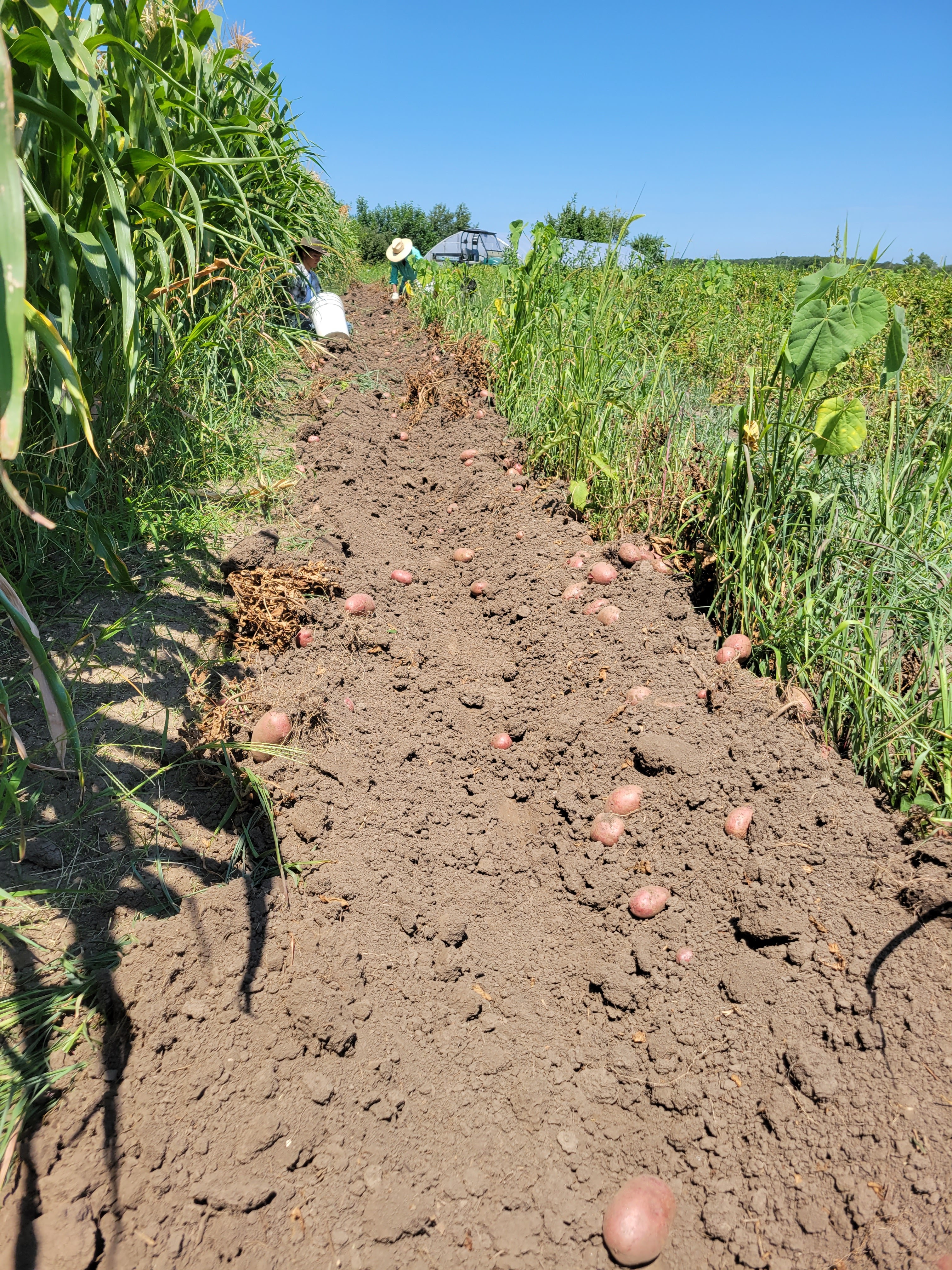
We also harvested all the Adirondak Red potatoes. We were quite pleased with the size and number that we found as red potatoes haven't produced as well for us in the past. We brought in about 360 pounds today. We'll start digging the other varieties soon.

And now it's time to start talking about the most important subject, TOMATOES! We are finally at the start of the season so it's time for the official introductions. Slicing tomatoes are on the "perhaps list" so not everyone will see them this week, but we promise they are coming soon! 
The smaller varieties tend to ripen first and we think we might have enough for everyone to get their first taste this week, so we'll start with those. As you can see, we raise a variety of colors of tomatoes, so color isn't your best indication of ripeness, touch is. A ripe tomato should yield to a gentle squeeze of your fingertips. If it feels hard, it's probably not quite ripe. Just leave it out on your counter for a day or 2 and try again.
 Here are the tomatoes that go into our "Jubilee Cherry Tomato Mix" also referred to as snacking tomatoes:

Black Cherry: Beautiful black cherry tomato with rich flavor.
Black Strawberry: Psychedelic, purple & red swirled cherry tomato.
Blush: yellow fruit with orange blush when fully ripe. Very low acid, meaty, and super sweet.
Bronze Torch: Green-striped red mini roma 
Gold Spark: sweet, yellow, bite-sized mini roma
Golden Rave: Small 1–2 oz yellow, plum shaped tomatoes with good tomato flavor. 
Honeydrop: sweet, fruity, yellow bite-sized tomatoes
Juliet: Small 1 – 2 oz red mini-roma, perfect flavor and shape for slicing onto pizza or salad.
Orange Paruche: 1" glowing orange globes that are sweet and flavorful.
Sunrise Bumblebee:  Bite sized swirls of red and orange, inside the fruit and out with a sweet, fruity taste, 
Sweetie: Bite-sized, sweet red cherry tomato
Tommy Toe: Large round red cherry with big tomato flavor

And now our slicing  tomatoes (all except Granadero & Marmalade are heirlooms):
Azoycha: Lemon-yellow medium-sized fruits with sweet, yet rich flavor.
Cosmonaut Volkov: medium-large red slicer with a full-rich flavor
Dagma's Perfection: Medium-sized, slightly flattened, pale-yellow fruits with delicate, light red striping.
Dr. Wychee Yellow: Large orange tomato with meaty, rich tasting flavor.
Granadero: Red plum tomato with thick-walled fruit; ideal for fresh tomato sauces, salsas, and salads
Green Zebra: Small, 2 1/2" olive yellow with green stripes and a sweet zingy flavor
John Baer: meaty red heirloom slicer
Marmalade: round, orange fruits with sweet tomato flavor
Matina: Red, golf-ball sized fruits with big, well-balanced flavor
Paul Robeson: Large, brick-red fruits with dark green shoulders. Has a sweet, rich, smoky flavor.
Pantano Romanesco: A large, deep red Roman heirloom. The flesh is very rich, flavorful & juicy.
Redfield Beauty: 3”– 4” flat pink fruits with excellent, full flavor.
Rutgers: large, red with excellent flavor for fresh eating or canning
White Queen: Medium-sized, smooth white-skinned tomato with sweet, juicy flesh, low acid.
Wisconsin 55: A flavorful medium-sized variety that is juicy, firm and ideal for slicing, cooking, and salads

Crew Corner: Joelle
Hello from Joelle! This is my second year at BGF and I have been learning a lot more about vegetables under the tutelage of my oldest sister Danielle. One of my favorite things to harvest is strawberries- and the season is way too short for my taste!
Because of my love for science…I also very much enjoy studying all the bugs and various wildlife wandering across my path in different areas around the farm…field mice…not so much!  
Although they are creepy, and an unpleasant aspect of the farm, it is still fun to look at ticks close-up with my new pocket microscope! I also enjoyed looking at a ladybug that I found who had a hole in her back…I could see down inside. That was fascinating!
If you by chance find a little nature in your CSA box-give it a look over and then consider releasing it in your own yard or a city park.


A little detail on your produce this week:


Basil hates the cold and will turn black with exposure. Keep long stemmed basil in a glass/vase of water on your counter top (out of direct sunlight). Stems that are too short (trimmings/tops) should be placed in a plastic bag, with a dry paper towel. Then put inside of a paper bag (for insulation) and put in the warmest part of your refrigerator (usually the door) or on the top shelf towards the front.

Beans: Fresh beans are an easy "store." Just leave them in their plastic bag and keep them in the produce drawer. Can last up to 2 weeks.

Beets- Cut off greens, leaving an inch of stem. Refrigerate the unwashed greens in a closed plastic bag and use with your chard mix as beets and chard are closely related. Store the beet roots, unwashed, with the rootlets (or “tails”) attached, in a plastic bag in the crisper bin of your refrigerator. They will keep for several weeks, but their sweetness diminishes with time. Just before cooking, scrub beets well and remove any scraggly leaves and rootlets. If your recipe calls for raw beets, peel them with a knife or vegetable peeler, then grate or cut according to your needs baby/young beets usually don't need to be peeled.

Broccoli & Cauliflower: Wrap loosely in a plastic bag and keep it in the vegetable bin of your refrigerator for up to a week. Immediately before cooking, soak head down, in cold, salted water (1 teaspoon salt to a 8 cups of water) for 5 minutes. Any [organic] critters will float to the top where you can rescue them or allow them to suffer a salty death. (Note: If you soak broccoli or cauliflower in salt water before storing, it will become too rubbery and wilted to enjoy.)

Cabbage: Store dry, unwashed cabbage in the refrigerator, preferably in the vegetable bin. The outer leaves may eventually get floppy or yellowish, but you can remove and discard them to reveal fresh inner leaves. Cabbage can keep for more than a month. Once it’s cut, seal it in a plastic bag and continue to refrigerate for several weeks. Rinse the cabbage under cold running water just before use. Peel away a few of the outer leaves, then cut the cabbage according to your needs with a big, sharp knife, and then chop, sliver, or grate. Our favorite way to eat raw cabbage is as a "walking salad" which is to simply spread peanut butter over a leaf of cabbage, sprinkle with your favorite dried fruit, roll it up into a tube and enjoy. This is a kid-pleaser for sure!

Cantaloupe: If your cantaloupe seems a bit short of ripe, keep it at room temperature for a few days or until there is a sweet smell coming from the stem end. Once the melon ripens, store it in the refrigerator. It is best not to cut a cantaloupe until you are ready to eat it. If you need to return cut melon to the refrigerator, do not remove the seeds from the remaining sections as they keep the flesh from drying out. Use within 3-5 days.

Cucumber: Store unwashed cucumbers in a sealed plastic bag in the vegetable crisper bin for about a week. Keep cucumbers tucked far away from tomatoes, apples, and citrus—these give off ethylene gas that accelerates cucumber deterioration. You can do a lot of fancy things to the skin of a cucumber, but when it is young, fresh (and unwaxed), it really only needs to be thoroughly washed. However, if the skin seems tough or bitter you can remove it; if the seeds are bulky, slice the cucumber lengthwise and scoop them out.

Eggplant: prefers to be kept at about 50° F, which is warmer than most refrigerators and cooler than most kitchen counters. Wrap unwashed eggplant in a towel (not in plastic) to absorb any moisture and keep it in the vegetable bin of your refrigerator. Used within a week, it should still be fresh and mild. Many people like to peel, salt, and drain their eggplant to draw out any bitter flavor; however, bitterness develops only in eggplant that has been stored for a while, so with farm-fresh specimens this is generally not necessary. Many recipes call for salting in order to make the vegetable less watery and more absorbent—much like draining tofu. Salting is not an essential step, but it can greatly enhance the taste and texture of your dish and is well worth the extra effort.

Green top onions/shallots: not the pencil-thin scallions, but nearly grown (though not-yet-cured) onions are an early summer treat. Keep sweet mild onions in a plastic bag in the refrigerator for a week or two, but beware the fatal moisture accumulation that causes them to spoil. To prolong their storage, wrap in a paper or cloth towel before storing in plastic. Also, don't just toss the tops, several years ago a CSA member taught us a great recipe to use them! See recipe below.

Okra: These lovely, dark red, horn-shaped vegetables are a warm weather treat. Extremely cold sensitive, store in their plastic bag in the warmest part of your fridge, or place the plastic bag in a small paper sack and store in the crisper drawer and use within the week. Traditional southerners will cut into rounds, bread in cornmeal and fry, but our favorite version is our dear friend Annie's method, "All I do is rinse off the pods and lay them in a saucepan with a little water in the bottom. Ten to fifteen minutes is all it takes...twenty if the pods are really big and "woody" feeling. I put salt on them and eat as finger food. It reminds me of young sweet corn."

Summer Squash/Zucchini: Refrigerate unwashed zucchini and summer squash for up to a week and a half in a perforated plastic bag or in a sealed plastic container lined with a kitchen towel. These do not need to be peeled to use, just slice them up and go!

Tomatoes: always store whole tomatoes at room temperature, out of direct sunlight. Once cut, store in a sealed container in the refrigerator.


A few other details: All of your GREENS will keep best if stored in a plastic bag, with the top folded over and placed in the produce drawer of your refrigerator.  

** NOTE: You will notice over the course of the season that some box contents listed above say "Perhaps one of the following..."  These are items that we can’t harvest in sufficient quantities for the whole CSA to receive at one time.  We do track who gets what and we will do our best to ensure that everyone eventually receives each item.  On some items this may take several weeks, so please be patient.

Is a weekly newsletter not enough for you? Do you want to read more about our life on the farm and see more pictures? Follow us on Facebook at Blue Gate Farm or on Instagram at bluegatefarmfresh. CSA members can also connect with other BGF members to share recipes or ask questions on our FB community page at Blue Gate Farm Community.

That's about it for now.
If you have any questions or comments, be sure to let us know.
Best from the farm,
Jill & Sean (and the whole BGF crew)

Luci & Sky