Showing posts with label choi. Show all posts

Tuesday, July 23, 2024

BGF NEWS - July 23, 2024 - VOL. 52, NO. 8

In this week’s box:

Basil: Sweet
Beans: Yellow & Green Mix
Broccoli: heads or florets with edible leaves
Cucumbers: Corinto, Generally, Marketmore or Dragon
Choi
Green-top Onions
Head Lettuce, assorted varieties
Purslane
Summer Squash: Golden Glory, Patty Pan, Safari, Slik Pik, or Zephyr

and perhaps one of the following: (see **NOTE below)
Cauliflower: Japanese
Cherry Tomatoes: Mix
Okra: Bowling Red, Candle Fire and Okinawa Pink
Peas: Snow or Sugar Snap


Herb It! option: Thai Basil, Par-cel, Sorrel


Featured Recipes:
(use purslane in place of spinach in recipe)

What’s up on the farm?

Precipitation in the past week: 0.00"


Despite the fact that we missed all the area rains in the past 2 weeks, we have definitely been loving the temperatures! It's been a welcome break from the heat for the crew and the animals, even the beans have been celebrating by getting back into production!

With the dry weather we've been clearing a lot of spent crops and cultivating beds to try and stay ahead of the weeds. We've gotten caught up on our fall crop seeding for now, though we have to run the irrigation to get the seeds to germinate. Earlier in the season we were so wet that some of our irrigation lines were never installed in our El Sur and El Norte fields. At that time we didn't need them and other tasks were higher priority. This week has brought home the need for those lines, so irrigation work is at the top of the list for later this week.

And now it's time to start talking about the most important subject, TOMATOES! We are finally at the start of the season so it's time for the official introductions. The smaller varieties tend to ripen first so we're starting with those, even though we won't have enough for everyone this week. Slicing tomatoes are coming, but we are probably at least two weeks out from our first harvest. 
 As you can see, we raise a variety of colors of tomatoes, so color isn't your best indication of ripeness, touch is. A ripe tomato should yield to a gentle squeeze of your fingertips. If it feels hard, it's probably not quite ripe. Just leave it out on your counter for a day or 2 and try again.
 Here are the tomatoes that go into our "Jubilee Cherry Tomato Mix" also referred to as snacking tomatoes:

Black Cherry: Beautiful black cherry tomato with rich flavor.
Blush: yellow fruit with orange blush when fully ripe. Very low acid, meaty, and super sweet.
Blush Cross: Three assorted seeding crosses of Blush and Juliet.
Bronze Torch: Green-striped red mini roma 
Chadwick Cherry: 1 oz red cherry with delicious, sweet flavor
Citrine: A bright orange bite-sized cherry with a rich, balanced flavor
Favorita: 1" red cherry with big tomato flavor
Golden Rave: Small 1–2 oz yellow, plum shaped tomatoes with good tomato flavor. 
Juliet: Small 1 – 2 oz red mini-roma, perfect flavor and shape for slicing onto pizza or salad.
Sweetie: Bite-sized, sweet red cherry tomato

We're also sending out the first of the green-top onions this week. Unfortunately we got our onions planted really late this spring so they haven't sized up like we would normally expect by this time of the season, but small as they are, they are still tasty so we hope you enjoy them...and we hope that we can get them to grow some more!

A little detail on your produce this week:

Basil hates the cold and will turn black with exposure. Keep long stemmed basil in a glass/vase of water on your counter top (out of direct sunlight). Stems that are too short (trimmings/tops) should be placed in a glass or plastic container with a dry paper towel. Then put inside of a paper bag (for insulation) and put in the warmest part of your refrigerator (usually the door) or on the top shelf towards the front.

Beans: Fresh beans are an easy "store." Just leave them in their plastic bag and keep them in the produce drawer. Can last up to 2 weeks.

Broccoli/Cauliflower: Wrap loosely in a plastic bag and keep it in the vegetable bin of your refrigerator for up to a week. Immediately before cooking, soak head down, in cold, salted water (1 teaspoon salt to a 8 cups of water) for 5 minutes. Any [organic] critters will float to the top where you can rescue them or allow them to suffer a salty death. (Note: If soaked in salt water before storing, it will become too rubbery and wilted to enjoy.) Slice the juicy, edible stems and use them wherever florets are called for. Peel particularly thick skin before using.

Cabbage: Store dry, unwashed cabbage in the refrigerator, preferably in the vegetable bin. The outer leaves may eventually get floppy or yellowish, but you can remove and discard them to reveal fresh inner leaves. Cabbage can keep for more than a month. Once it’s cut, seal it in a plastic bag and continue to refrigerate for several weeks. Rinse the cabbage under cold running water just before use. Peel away a few of the outer leaves, then cut the cabbage according to your needs with a big, sharp knife, and then chop, sliver, or grate

Cucumber: Store unwashed cucumbers in a sealed plastic bag in the vegetable crisper bin for about a week. Keep cucumbers tucked far away from tomatoes, apples, and citrus—these give off ethylene gas that accelerates cucumber deterioration. You can do a lot of fancy things to the skin of a cucumber, but when it is young, fresh (and unwaxed), it really only needs to be thoroughly washed. However, if the skin seems tough or bitter you can remove it; if the seeds are bulky, slice the cucumber lengthwise and scoop them out.

Green-top onions: As you might note from their name, these are young, freshly pulled, uncured onions. They can be used as you would any onion, the difference is in the storage. Since they don't have a layer of dried skin to protect them, please store in a sealed bag or container in your refrigerator and plan to use within 2 weeks. As long as the greens are still fresh, you can use them like scallions.

Herbs: Generally, except for basil, set unwashed bunches of fresh herbs (with stems) upright into small jars filled with 1 to 2 inches of water, cover loosely with plastic wrap, and refrigerate for up to two weeks. Rinse fresh herbs right before use. To release their scents and flavors, rub them between your hands before mincing or chopping. If you have no idea what to do with fresh herbs, there is one great default answer "compound butter." Finely mince leaves and knead them into a stick of room temperature butter. Roll the butter into a log in plastic wrap and store in the freezer. Then simply slice off the amount you need to add delicious, ready-to-use flavor to vegetables, bread or meats.

Okra: These lovely, dark red, horn-shaped vegetables are a warm weather treat. Extremely cold sensitive, store in their plastic bag in the warmest part of your fridge, or place the plastic bag in a small paper sack and store in the crisper drawer and use within the week. Traditional southerners will cut into rounds, bread in cornmeal and fry, but our favorite version is our dear friend Annie's method, "All I do is rinse off the pods and lay them in a saucepan with a little water in the bottom. Ten to fifteen minutes is all it takes...twenty if the pods are really big and "woody" feeling. I put salt on them and eat as finger food. It reminds me of young sweet corn."

Peas: We grow snow peas (flat pod with little bumps showing immature peas inside) and sugar snap peas (rounded pods with mature peas inside). Both have edible pods and can be used interchangeably in recipes. They are particularly good in stir-fries and salads, though we tend to eat them fresh as a snack. Peas keep best in their plastic container in the produce drawer of your refrigerator.

Purslane: Considered an invasive weed in many gardens, purslane is a valued green in many parts of the world. The plant is rich in vitamin E, vitamin C and beta carotene, and quite high in protein.  Most noteworthy of all, it is considered a better source of essential omega-3 fatty acids than any other leafy plant.  Enjoy raw or cooked in any recipe calling for greens.   We particularly like it in salads, cooked with eggs and as a lettuce replacement in tacos. Store in a paper towel-lined plastic bag in your crisper drawer and use within a week.

Summer Squash/Zucchini: Refrigerate unwashed zucchini and summer squash for up to a week and a half in a perforated plastic bag or in a sealed plastic container lined with a kitchen towel. These do not need to be peeled to use, just slice them up and go!

Tomatoes: always store whole tomatoes at room temperature, out of direct sunlight. Once cut, store in a sealed container in the refrigerator.

A few other details: All of your GREENS will keep best if stored in a plastic bag, with the top folded over and placed in the produce drawer of your refrigerator.

** NOTE: You will notice over the course of the season that some box contents listed above say "Perhaps one of the following..." These are items that we can’t harvest in sufficient quantities for the whole CSA to receive at one time. We do track who gets what and we will do our best to ensure that everyone eventually receives each item. On some items this may take several weeks, so please be patient.

Is a weekly newsletter not enough for you? Do you want to read more about our life on the farm and see more pictures? Follow us on Facebook at Blue Gate Farm or on Instagram at bluegatefarmfresh. CSA members can also connect with other BGF members to share recipes, photos or ask questions on our FB community page at Blue Gate Farm Community.

That's about it for now.
If you have any questions or comments, be sure to let us know.
Best from the farm,
Jill & Sean (and the whole BGF crew)


Tuesday, July 9, 2024

BGF NEWS - July 9, 2024 - VOL. 52, NO. 6

In this week’s box:

Basil: Sweet
Beans: Yellow & Green Mix
Beets: Cylindra
Choi: Black Summer
Cucumbers: Corinto, Marketmore or Dragon
Head Lettuce, assorted varieties
Scallions
Summer Squash: Golden Glory, Patty Pan, Safari, Slik Pik, or Zephyr

and at least one of the following: (see **NOTE below)
Broccoli: heads or florets with edible leaves
Cauliflower: Japanese
Eggplant: Orient Express
Peas: Snow or Sugar Snap

Herb It! option: Thai Basil, Bronze Fennel, Savory

Featured Recipes:
BGF Summer Garden Pasta **see recipe below**

What’s up on the farm?
Precipitation in the past week: 1.5"

What a lovely weather week on the farm! The temperatures have been fabulous, the rains have been timely and gentle, the farm crew got a full day off for the 4th AND we made good forward progress in the fields. We'll take it!

This is the time of the season when we start to shift more hours towards harvesting than field maintenance (though the crew would probably argue there are still TOO MANY hours cultivating.) Regardless of our other tasks, crops like summer squash, cucumbers, beans and okra have to be harvested every other day. This keeps the fruits at their peak quality and cues the plants to keep producing. 

Speaking of beans, we were shocked when we harvested Friday and yesterday that there were so few beans to pick. We were expecting a big yield after last week's opening set. But there was almost nothing. After a little head scratching we looked back at the farm calendar and noted that 3 weeks ago we had that stretch of 90°+ degree days. Bean pollen is sterilized at those temperatures so although our plants are nice and healthy, none of the blooms during that time produced any fruits. They are blooming now, but we will have a pause in our bean production while the plants get going again. So enjoy those smaller bags of beans this week, it will be a couple of weeks before we are in full bean production again.

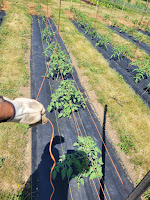
Besides harvesting, our big tasks this week were getting the first couple of lines installed on the tomato trellises (and tucking in all the plants), clearing all the spent early greens and more cultivating.  The recently sown fall transplants have germinated and moved out to the high tunnel to grow up a bit before they are planted in the fields. More fall crops will be sown this week.

Now with the whole farm in production we are seeing lots of visitors arrive to enjoy our progress. Some of them are valued team members, some fun guests and some are just obnoxious party crashers that no one wants to find. I'll let you guess who is who!


A little detail on your produce this week:

Basil hates the cold and will turn black with exposure. Keep long stemmed basil in a glass/vase of water on your counter top (out of direct sunlight). Stems that are too short (trimmings/tops) should be placed in a glass or plastic container with a dry paper towel. Then put inside of a paper bag (for insulation) and put in the warmest part of your refrigerator (usually the door) or on the top shelf towards the front.

Beans: Fresh beans are an easy "store." Just leave them in their plastic bag and keep them in the produce drawer. Can last up to 2 weeks.

Broccoli/Cauliflower: Wrap loosely in a plastic bag and keep it in the vegetable bin of your refrigerator for up to a week. Immediately before cooking, soak head down, in cold, salted water (1 teaspoon salt to a 8 cups of water) for 5 minutes. Any [organic] critters will float to the top where you can rescue them or allow them to suffer a salty death. (Note: If soaked in salt water before storing, it will become too rubbery and wilted to enjoy.) Slice the juicy, edible stems and use them wherever florets are called for. Peel particularly thick skin before using.

Beets: Cut off greens, leaving an inch of stem. Refrigerate the unwashed greens in a closed plastic bag and use with your chard mix as beets and chard are closely related. Store the beet roots, unwashed, with the rootlets (or “tails”) attached, in a plastic bag in the crisper bin of your refrigerator. They will keep for several weeks, but their sweetness diminishes with time. Just before cooking, scrub beets well and remove any scraggly leaves and rootlets. If your recipe calls for raw beets, peel them with a knife or vegetable peeler, then grate or cut according to your needs baby/young beets usually don't need to be peeled.

Choi (a.k.a. - pac choi, bok choy or pok choy) is a member of the cabbage family and is a traditional Asian stir-fry vegetable.  Both the stems and leaves of choi can be used and are especially tasty in cooked recipes.  If cooking them, separate the leaves and stems, and begin cooking stems first to avoid overcooking the more tender greens. You can also use the leaves like any green-leafy vegetable and the stems like celery.  We tend to use choi leaves as a sandwich wrap, or just roughly chop the whole thing and sauté with garlic and/or onion.  Cook until stems are tender and dress with a little seasoned rice vinegar. Store choi loosely wrapped in a plastic bag in your produce drawer.

Cucumber: Store unwashed cucumbers in a sealed plastic bag in the vegetable crisper bin for about a week. Keep cucumbers tucked far away from tomatoes, apples, and citrus—these give off ethylene gas that accelerates cucumber deterioration. You can do a lot of fancy things to the skin of a cucumber, but when it is young, fresh (and unwaxed), it really only needs to be thoroughly washed. However, if the skin seems tough or bitter you can remove it; if the seeds are bulky, slice the cucumber lengthwise and scoop them out.

Eggplant: Eggplant prefers to be kept at about 50° F, which is warmer than most refrigerators and cooler than most kitchen counters. Wrap unwashed eggplant in a towel (not in plastic) to absorb any moisture and keep it in the vegetable bin of your refrigerator. Used within a week, it should still be fresh and mild. Many people like to peel, salt, and drain their eggplant to draw out any bitter flavor; however, bitterness develops only in eggplant that has been stored for a while, so with farm-fresh specimens this is generally not necessary. Many recipes call for salting in order to make the vegetable less watery and more absorbent—much like draining tofu. Salting is not an essential step, but it can greatly enhance the taste and texture of your dish and is well worth the extra effort. The shape of an eggplant determines how it is best prepared. Slice a straight, narrow eggplant into rounds for grilling or broiling, and cut a rounded, bulbous eggplant into cubes for stews and stir-fries.

Herbs: Generally, except for basil, set unwashed bunches of fresh herbs (with stems) upright into small jars filled with 1 to 2 inches of water, cover loosely with plastic wrap, and refrigerate for up to two weeks. Rinse fresh herbs right before use. To release their scents and flavors, rub them between your hands before mincing or chopping. If you have no idea what to do with fresh herbs, there is one great default answer "compound butter." Finely mince leaves and knead them into a stick of room temperature butter. Roll the butter into a log in plastic wrap and store in the freezer. Then simply slice off the amount you need to add delicious, ready-to-use flavor to vegetables, bread or meats.

Peas: We grow snow peas (flat pod with little bumps showing immature peas inside) and sugar snap peas (rounded pods with mature peas inside). Both have edible pods and can be used interchangeably in recipes. They are particularly good in stir-fries and salads, though we tend to eat them fresh as a snack. Peas keep best in their plastic container in the produce drawer of your refrigerator.

Scallions (green onions)- are best kept upright in a glass with about 1" of water in it, more like flowers than vegetables. Loosely cover the tops with plastic and you will be amazed at how long they will keep. We like to throw a handful of chopped scallions into nearly any savory dish, right near the end of the cooking time.

Summer Squash/Zucchini: Refrigerate unwashed zucchini and summer squash for up to a week and a half in a perforated plastic bag or in a sealed plastic container lined with a kitchen towel. These do not need to be peeled to use, just slice them up and go!

A few other details: All of your GREENS will keep best if stored in a plastic bag, with the top folded over and placed in the produce drawer of your refrigerator.

** NOTE: You will notice over the course of the season that some box contents listed above say "Perhaps one of the following..." These are items that we can’t harvest in sufficient quantities for the whole CSA to receive at one time. We do track who gets what and we will do our best to ensure that everyone eventually receives each item. On some items this may take several weeks, so please be patient.

Is a weekly newsletter not enough for you? Do you want to read more about our life on the farm and see more pictures? Follow us on Facebook at Blue Gate Farm or on Instagram at bluegatefarmfresh. CSA members can also connect with other BGF members to share recipes, photos or ask questions on our FB community page at Blue Gate Farm Community.
That's about it for now.
If you have any questions or comments, be sure to let us know.
Best from the farm,
Jill & Sean (and the whole BGF crew)


BGF Summer Garden Pasta

Small bunch young beets, assorted colors with greens
1 tbs Olive Oil
1 tsp garlic, minced or garlic scapes, chopped
1 cup fresh beans or peas, stemmed and snapped into bite-sized pieces
2 tbs Dried Tomatoes, chopped or 2-4 Small fresh tomatoes, chopped
Feta Cheese. crumbled
1 tbs Balsamic vinegar
1 tbs fresh basil, cut into a chiffonade
Penne pasta

Prepare pasta according to directions.
While pasta is cooking, separate beets from greens (discard stems), cut beets into quarters or eighths and cut beet greens into a chiffonade.
Place dried tomatoes into a small heat-proof dish. When pasta is about half done, take 2 tbs of pasta water and pour over dried tomatoes to re-hydrate.
Place olive oil, garlic, beets and beans into a sauté pan over medium heat for 3-4 minutes, stirring often. Remove dried tomatoes from liquid (reserving liquid) and add tomatoes to sauté pan along with beet greens. Cook until greens are wilted and bright green.  Remove from heat.
Place pasta in a serving bowl, add sauted vegetables, fresh tomatoes and feta cheese. Sprinkle with reserved water from dried tomatoes, balsamic vinegar and basil, toss gently.
Tasty served warm or at room temp.

This recipe serves two as a main dish, but is easy to multiply to feed any number.

Recipe source: Blue Gate Farm

Tuesday, June 18, 2024

BGF NEWS - June 18, 2024 - VOL. 52, NO. 3

In this week’s box:

Baby Carrots
Basil Tips
Choi: Prize
Garlic Scapes (the green, curly things)
Green Garlic
Head Lettuce, assorted varieties
Lemon Thyme
Napa

and perhaps one of the following: (see **NOTE below)
Broccoli
Cauliflower: Japanese
Peas- Snow or Sugar Snap

Herb It! option: will start in a couple weeks as the annual herbs mature


Featured Recipes:  
BGF Eggroll in a Bowl **see recipe below

What’s up on the farm?
Precipitation in the past week: 0.25"

We're never really ready for the first stretch of 90+ degree days but nature is rarely accommodating enough to wait for us. The heat is on and most of the rain has continued to miss us, so we've been pushing to get the rest of the irrigation system in place and to make a couple of upgrades. We're about 3/4 of the way done.
The heat also means that it takes us longer to get tasks done as we need to take more water and shade breaks. Plus there's the ever popular alpaca "showers" to contend with.

We've also been doing a lot of cultivating this week, trying to take advantage of the dry conditions while we can. After the extended wet season, the soil has baked into a flat adobe-like surface and we've really struggled to break it up. That added to the high temperatures has made for some challenging conditions for the crew.

The higher temps are also bring our cool season crops to an end. This will be the final delivery of choi for a while and we will clear the misome later this week. But never fear, there are good things coming soon! The basil is finally putting on some growth and needed to be pinched back, so we are sending out a little "tease" of basil tips this week. The beans, peppers and eggplants are blooming and we are seeing the first little tomatoes, summer squashes and cucumbers setting on.

A little detail on your produce this week:


Basil hates the cold and will turn black with exposure. Keep long stemmed basil in a glass/vase of water on your counter top (out of direct sunlight). Stems that are too short (trimmings/tops) should be placed in a glass or plastic container with a dry paper towel. Then put inside of a paper bag (for insulation) and put in the warmest part of your refrigerator (usually the door) or on the top shelf towards the front.


Broccoli/Cauliflower: Wrap loosely in a plastic bag and keep it in the vegetable bin of your refrigerator for up to a week. Immediately before cooking, soak head down, in cold, salted water (1 teaspoon salt to a 8 cups of water) for 5 minutes. Any [organic] critters will float to the top where you can rescue them or allow them to suffer a salty death. (Note: If soaked in salt water before storing, it will become too rubbery and wilted to enjoy.) Slice the juicy, edible stems and use them wherever florets are called for. Peel particularly thick skin before using.

Carrots: These baby carrots are sweet and tender, we don't even peel them, just give them a quick scrub and they are ready to go! Remove the leafy green tops, leaving about an inch of stems. Refrigerate dry, unwashed carrots in a plastic bag for two weeks or longer. Peel carrots or scrub carrots well with a stiff brush just before using. Trim off any green spots, which can taste bitter. When slicing or chopping carrots for cooking, be sure to make all the pieces relatively the same size; this will ensure an evenly cooked dish. Greens can be added to soup stock for flavor.

Garlic Scapes: One of our favorite crops of the year. These curly green things are the emerging flower stalk from a hardneck garlic plant. We remove them to redirect more of the plant's energy into the bulb, but it also provides us with a delightful fresh garlic treat. These keep very well in a plastic bag in your produce drawer and can be used in any recipe calling for garlic. They would be perfect in last week's garlic salt recipe, make a great pesto and can be minced and added to room-temperature butter, which is then stored in log shape, in the freezer for a last minute dollop of goodness for vegetables, breads or meat.

Green Garlic: This is freshly harvested garlic that hasn't had time to cure yet. You will notice that the wrappers are soft and the garlic itself is very juicy. You can use it in any recipe calling for garlic. The flavor is so fresh and green that we like to use them in recipes that really highlight the flavor, like pesto or garlic butter. Store in a jar or other glass container in the refrigerator for best keeping quality.

Herbs: Generally, except for basil, set unwashed bunches of fresh herbs (with stems) upright into small jars filled with 1 to 2 inches of water, cover loosely with plastic wrap, and refrigerate for up to two weeks. Rinse fresh herbs right before use. To release their scents and flavors, rub them between your hands before mincing or chopping. If you have no idea what to do with fresh herbs, there is one great default answer "compound butter." Finely mince leaves and knead them into a stick of room temperature butter. Roll the butter into a log in plastic wrap and store in the freezer. Then simply slice off the amount you need to add delicious, ready-to-use flavor to vegetables, bread or meats.

Peas: We grow snow peas (flat pod with little bumps showing immature peas inside) and sugar snap peas (rounded pods with mature peas inside). Both have edible pods and can be used interchangeably in recipes. They are particularly good in stir-fries and salads, though we tend to eat them fresh as a snack. Peas keep best in their plastic container in the produce drawer of your refrigerator.

A few other details: All of your GREENS will keep best if stored in a plastic bag, with the top folded over and placed in the produce drawer of your refrigerator.

** NOTE: You will notice over the course of the season that some box contents listed above say "Perhaps one of the following..." These are items that we can’t harvest in sufficient quantities for the whole CSA to receive at one time. We do track who gets what and we will do our best to ensure that everyone eventually receives each item. On some items this may take several weeks, so please be patient.


Is a weekly newsletter not enough for you? Do you want to read more about our life on the farm and see more pictures? Follow us on Facebook at Blue Gate Farm or on Instagram at bluegatefarmfresh. CSA members can also connect with other BGF members to share recipes, photos or ask questions on our FB community page at Blue Gate Farm Community.
That's about it for now.
If you have any questions or comments, be sure to let us know.
Best from the farm,
Jill & Sean (and the whole BGF crew)


BGF Egg Roll In A Bowl

Yield: serves 4

  • 1 pound ground pork sausage
  • 4-6 cups shredded napa cabbage
  • ½ - 1 cup grated or matchstick carrots
  • 4 cloves garlic or 4-6 garlic scapes, minced
  • 1 tablespoon ginger, minced
  • 1 tablespoon soy sauce
  • 1/4 cup chopped scallions
  • 1 tablespoon sesame oil


  1. Heat a large skillet over medium heat. Add the sausage and cook, stirring often to crumble, until cooked through. Do not drain.
  2. Add the cabbage, garlic, ginger, and soy sauce to the skillet with the sausage. Cook for 3-4 minutes or until cabbage has softened a bit.
  3. Remove from the heat and top with scallions and drizzle with sesame oil.
  4. Serve immediately.

Recipe Source: Blue Gate Farm, adapted from http://www.bunsinmyoven.com


Tuesday, June 11, 2024

BGF NEWS - June 11, 2024 - VOL. 52, NO. 2

In this week’s box:

Choi-Beijing Express
Daikon
Garlic Scapes (the green, curly things)
Golden Oyster Mushrooms
Head Lettuce, assorted varieties
Lemon Balm
Peas- Snow or Sugar Snap
Swiss "Cheese" Chard
Tapestry Popcorn

and perhaps one of the following: (see **NOTE below)
Broccoli
Cauliflower: Japanese

Herb It! option: will start in a few weeks as the annual herbs mature


Featured Recipes:  
Napa Cabbage & Mushrooms (use Beijing Express & oysters)
The Great Chard E'Scape **see recipe below**

What’s up on the farm?
Precipitation in the past week: Trace

It's been a week of progress on the farm! 
I feel like we touched every inch of crop soil that is under cultivation this year.  On Wednesday the crew cleared the big high tunnel of early season crops and replanted to warm weather crops like cucumbers, basil, peppers and celery. 

We also got the last of more than 400 dahlia tubers planted, plus sowed more beans, edamame and fennel. After that we grabbed our cultivating tools and hit all the planted fields. Thousands of weeds were evicted from the crop ground (insert villainous laugh here). We finally look more like a vegetable farm again and less of a weed farm. We even managed to get the potatoes hilled twice.
Hopefully we will get at least one more hilling before they get too tall. Speaking of potatoes, we've also been scouting the potato plot every few days for the dreaded potato beetle larva, and boy, have we found them! This is about the worst that we've had them in recent years. Since we are chemical-free, the way we manage them is to pick them off by hand and drop them into soapy water. We have about 3,500 row feet of potatoes, so it takes some time to inspect every plant, but it's worth it!
Gross, nasty things!
They ate every leaf off this plant

We managed to miss all the rain last week, which is how we were able to get so much field work done, but it also means we had to start irrigating our crops. We only have part of the system in, since we hadn't needed it earlier, and the unirrigated crops are getting jealous and threatening a walk out. So we'll spend some time later this week getting the rest of the lines run and giving everyone a good soak. Maybe we'll also get lucky and it will rain!

A couple of notes about things in your box this week. You may have noticed in the box contents list above that we included Swiss" Cheese" Chard. No, it isn't an actual cheesy vegetable, our chard plants were damaged in a hail storm earlier this season. The leaves are perfectly good, they just have cosmetic damage (hail holes) so we hated to just compost them so we decided to send them out and hope you can forgive their "holiness". 
On a more fun note, we are also sending out popcorn this week. This is the first time we've included our Tapestry Popcorn in the CSA delivery, but we had a record-breaking harvest last fall and wanted to share the bounty. It's been in cold storage all this time, so it pops beautifully. It's one of our favorite crops (and treats) and we hope you enjoy it! 
And finally we are sending out the first of the broccoli and cauliflower in some boxes this week. The early season weather was hard on the plants and they are heading out while the plants are still too small. This means the heads are also small, especially on the broccoli. Never fear, there should be more to come.  We grow a variety of cauliflower that may be unfamiliar to some of you, it's a Japanese variety and it's form is more open than traditional cauliflower, making it a cinch to cut into small florets. It's also extra tender and sweeter than other varieties. We love it and hope you do too!

A little detail on your produce this week:


Broccoli/Cauliflower: Wrap loosely in a plastic bag and keep it in the vegetable bin of your refrigerator for up to a week. Immediately before cooking, soak head down, in cold, salted water (1 teaspoon salt to a 8 cups of water) for 5 minutes. Any [organic] critters will float to the top where you can rescue them or allow them to suffer a salty death. (Note: If soaked in salt water before storing, it will become too rubbery and wilted to enjoy.) Slice the juicy, edible stems and use them wherever florets are called for. Peel particularly thick skin before using.

Daikon: Trim the tops and roots. Peel if you like (though not necessary). Daikon will last up to 2 weeks stored in the fridge in plastic bag or wrapped in damp towel in fridge. 


Garlic Scapes: One of our favorite crops of the year. These curly green things are the emerging flower stalk from a hardneck garlic plant. We remove them to redirect more of the plant's energy into the bulb, but it also provides us with a delightful fresh garlic treat. These keep very well in a plastic bag in your produce drawer and can be used in any recipe calling for garlic. They would be perfect in last week's garlic salt recipe, make a great pesto and can be minced and added to room-temperature butter, which is then stored in log shape, in the freezer for a last minute dollop of goodness for vegetables, breads or meat.


Herbs: Generally, except for basil, set unwashed bunches of fresh herbs (with stems) upright into small jars filled with 1 to 2 inches of water, cover loosely with plastic wrap, and refrigerate for up to two weeks. Rinse fresh herbs right before use. To release their scents and flavors, rub them between your hands before mincing or chopping. If you have no idea what to do with fresh herbs, there is one great default answer "compound butter." Finely mince leaves and knead them into a stick of room temperature butter. Roll the butter into a log in plastic wrap and store in the freezer. Then simply slice off the amount you need to add delicious, ready-to-use flavor to vegetables, bread or meats.

Oyster Mushrooms: To maximize the shelf life of raw mushrooms, refrigerate them in a paper bag; do not wrap in plastic or store in airtight container, as this will speed spoilage. Properly stored, raw whole mushrooms will usually keep well for 4 to 7 days in the fridge. To use, trim off the stems as they are tough and either discard them or save to make a vegetable stock. Please be sure to cook all mushrooms before consuming.

Peas: We grow snow peas (flat pod with little bumps showing immature peas inside) and sugar snap peas (rounded pods with mature peas inside). Both have edible pods and can be used interchangeably in recipes. They are particularly good in stir-fries and salads, though we tend to eat them fresh as a snack. Peas keep best in their plastic container in the produce drawer of your refrigerator.

Popcorn: Good for microwave, stovetop or air popper (stovetop is our favorite). Store at room temperature in an airtight container for 3-6 months or in the freezer for up to a year.


A few other details: All of your GREENS will keep best if stored in a plastic bag, with the top folded over and placed in the produce drawer of your refrigerator.

** NOTE: You will notice over the course of the season that some box contents listed above say "Perhaps one of the following..." These are items that we can’t harvest in sufficient quantities for the whole CSA to receive at one time. We do track who gets what and we will do our best to ensure that everyone eventually receives each item. On some items this may take several weeks, so please be patient.


Is a weekly newsletter not enough for you? Do you want to read more about our life on the farm and see more pictures? Follow us on Facebook at Blue Gate Farm or on Instagram at bluegatefarmfresh. CSA members can also connect with other BGF members to share recipes, photos or ask questions on our FB community page at Blue Gate Farm Community.
That's about it for now.
If you have any questions or comments, be sure to let us know.
Best from the farm,
Jill & Sean (and the whole BGF crew)


The Great Chard E’Scape
1 big bunch Swiss chard
1 tbs olive oil
5-6 fresh garlic scapes (or more to taste) or 1-3 cloves minced garlic
Sea salt
Optional: Seasoned Rice Vinegar

Cut garlic scapes into bite-sized pieces. In a large skillet, heat oil over medium-high heat. Add garlic scapes. Trim large stems from chard leaves. Cut stems into 1” pieces. Add stems to skillet. Stack chard leaves and roll into a tube. Cut into ½” strips. As scapes and stems just begin to soften, add leaves to skillet. Cook until leaves wilt. Sprinkle with salt to taste. A little shake of seasoned rice vinegar over the top is very tasty!

Great served over pasta with red sauce or as a side dish. Leftovers are tasty in eggs the next day.

Recipe Source: Blue Gate Farm

Monday, June 19, 2023

BGF NEWS - June 20, 2023 - VOL. 50, NO. 3

In this week’s box:


Beets: Cylindra
Baby Choi
Fennel
Garlic Scapes
Green Garlic
Head Lettuce, assorted varieties
Purslane
Sugar Snap Peas  

Snow Peas
Summer Squash: 8 Ball, Golden Glory, Slik Pik, Zephyr


and perhaps one of the following: (please see **NOTE after "A Little Detail..." below)
Broccoli: Gypsy
Cauliflower: Song (Japanese cauliflower)

Herb It! option: will start in a couple weeks as the annual herbs mature
Bread Share: Apple Bread

Featured Recipes:
Chinese Purslane Stir-fry

What’s up on the farm?

Precipitation in the past week: 0.45"

Well, technically we got our wish this week, it did rain. We got a little less than 1/2 inch between Saturday and Sunday. It was a lovely sight, but unfortunately just a "drop in the bucket" as the saying goes and we were back to playing round robin with the irrigation that day. 

We spent much of the past week in the tomato plot. Installing posts for trellising, pruning plants and putting in the first couple of rounds of trellising twine. This system is commonly called Florida Weave and it allows us to manage and harvest the plants more easily that using tomato cages. It does take more time and effort to install and manage than cages. We put in more than 250 tall steel posts to provide the structure and then by the end of the season will use about 32,000 feet of twine. However the plants have better airflow (less disease potential), are easier to harvest and much easier to manage for pest control and we don't have to store 700+ cages over the winter!

You won't be surprised to read that the balance of our week was filled with irrigating, cultivating, harvesting, a bit of hand weeding, clearing spent crops and transplanting head lettuce #6.

Harvesting time is increasing as we are now picking peas and summer squashes every other day. The high tunnel cucumbers will be added to that list later this week. Just one variety is producing right now and it will be a couple of weeks before the rest join in, but hopefully there will be many cucumbers in the not-to-distant future!

We are SO pleased with the photos that members have been submitting for the weekly "Show US Your Veg" photo contest! Thank you to everyone who has shared a pic and/or who have posted recipes/cooking ideas on the Community page. We love to see your ideas and meals! Keep up the great work!

A little detail on your produce this week:

Beets: Cut off greens, leaving an inch of stem. Refrigerate the unwashed greens in a closed plastic bag and use with your chard mix as beets and chard are closely related. Store the beet roots, unwashed, with the rootlets (or “tails”) attached, in a plastic bag in the crisper bin of your refrigerator. They will keep for several weeks, but their sweetness diminishes with time. Just before cooking, scrub beets well and remove any scraggly leaves and rootlets. If your recipe calls for raw beets, peel them with a knife or vegetable peeler, then grate or cut according to your needs baby/young beets usually don't need to be peeled.

Broccoli/Cauliflower: Wrap loosely in a plastic bag and keep it in the vegetable bin of your refrigerator for up to a week. Immediately before cooking, soak head down, in cold, salted water (1 teaspoon salt to a 8 cups of water) for 5 minutes. Any [organic] critters will float to the top where you can rescue them or allow them to suffer a salty death. (Note: If soaked in salt water before storing, it will become too rubbery and wilted to enjoy.) Slice the juicy, edible stems and use them wherever florets are called for. Peel particularly thick skin before using.

Fennel: Cut off the stalks where they emerge from the bulb. To use the feathery foliage as an herb, place the dry stalks upright in a glass filled with two inches of water, cover the glass loosely with a plastic bag, and store in the refrigerator for up to five days. The unwashed bulb will keep in a plastic bag in the refrigerator for at least a week. To use, remove any damaged spots or layers. Cut the bulb in half lengthwise and check the inner core. If it’s tough, remove it with a paring knife. Fennel should be washed carefully, because dirt can lodge between the layers of the bulb. Chop or mince the leaves.

Garlic Scapes: One of our favorite crops of the year. These curly green things are the emerging flower stalk from a hardneck garlic plant. We remove them to redirect more of the plant's energy into the bulb, but it also provides us with a delightful fresh garlic treat. These keep very well in a plastic bag in your produce drawer and can be used in any recipe calling for garlic. They would be perfect in last week's garlic salt recipe, make a great pesto and can be minced and added to room-temperature butter, which is then stored in log shape, in the freezer for a last minute dollop of goodness for vegetables, breads or meat.

Green Garlic: This is freshly harvested garlic that hasn't had time to cure yet. You will notice that the wrappers are soft and the garlic itself is very juicy. You can use it in any recipe calling for garlic. The flavor is so fresh and green that we like to use them in recipes that really highlight the flavor, like pesto or garlic butter.Store loosely wrapped in the refrigerator for best keeping quality.

Peas: We grow snow peas (flat pod with little bumps showing immature peas inside) and sugar snap peas (rounded pods with mature peas inside). Both have edible pods and can be used interchangeably in recipes. They are particularly good in stir-fries and salads, though we tend to eat them fresh as a snack. Peas keep best in their plastic container in the produce drawer of your refrigerator.

Purslane: This succulent plant is a valued green in many parts of the world, though here in the US, it is mostly known as an invasive weed. It is rich in vitamin E, vitamin C and beta carotene, and quite high in protein. Most noteworthy of all, it is considered a better source of essential omega-3 fatty acids than any other leafy plant. Enjoy raw or cooked in any recipe calling for greens, it is also ideal for juicing and green smoothies. Makes a terrific replacement for lettuce on tacos. Store in a paper towel (or cloth)-lined plastic bag in your crisper drawer and use within a week.


Summer Squash/Zucchini: Refrigerate unwashed zucchini and summer squash for up to a week and a half in a perforated plastic bag or in a sealed plastic container lined with a kitchen towel. These do not need to be peeled to use, just slice them up and go!

A few other details: All of your GREENS will keep best if stored in a plastic bag, with the top folded over and placed in the produce drawer of your refrigerator.

** NOTE: You will notice over the course of the season that some box contents listed above say "Perhaps one of the following..." These are items that we can’t harvest in sufficient quantities for the whole CSA to receive at one time. We do track who gets what and we will do our best to ensure that everyone eventually receives each item. On some items this may take several weeks, so please be patient.

Is a weekly newsletter not enough for you? Do you want to read more about our life on the farm and see more pictures? Follow us on Facebook at Blue Gate Farm or on Instagram at bluegatefarmfresh. CSA members can also connect with other BGF members to share recipes or ask questions on our FB community page at Blue Gate Farm Community.

That's about it for now.
If you have any questions or comments, be sure to let us know.

Best from the farm,
Jill & Sean (and the whole BGF crew)